
Laboratory testing of soils and rocks
Physical, physico-mechanical and chemical soil properties to GOST. Groundwater and water-extract analysis.
Soil laboratory testing is a comprehensive set of engineering geological works designed to obtain accurate data on the composition, physical state, and mechanical properties of soils. Retrieved field samples undergo rigorous laboratory examination to establish their physical, mechanical, and chemical characteristics.
All soil and groundwater tests are performed using methods established by regulatory standards (GOST, ASTM, and ShNK). The dedicated geotechnical soil testing laboratory Uzbekistan at the GEO PRO engineering center guarantees certified accuracy for every test protocol.
By executing routine soil laboratory testing Tashkent and across surrounding regions, our geotechnical engineers identify subsurface ground hazards before structural design begins. Comprehensive soil laboratory testing provides a sound baseline for foundation type selection and concrete durability design.
Accurate physical and mechanical soil properties testing allows structural engineers to predict the deformation response of underlying soil layers beneath shallow foundations, raft slabs, or deep driven piles.
Rigorous laboratory diagnostics eliminate the risks of structural foundation failure, uneven building settlement, and wall cracking.
Soil Laboratory Testing: Physical Properties and Index Classification
In accordance with the Urban Planning Code of the Republic of Uzbekistan, basic physical testing determines core classification benchmarks:
- determination of natural moisture content;
- mineralogical composition analysis;
- determination of soil bulk density and solid particle (skeleton) density;
- calculation of porosity and void ratio;
- plasticity index and consistency limits (Atterberg limits: liquid and plastic limits);
- particle size distribution (granulometric sieve analysis);
- susceptibility to collapse and volumetric swelling.
These index parameters determine the exact classification of the soil (sand, clay, loam, silt, or loess) and establish its suitability as a natural load-bearing foundation stratum.
Mechanical Strength: Triaxial and Shear Testing of Soils Tashkent
Engineers at GEO PRO test undisturbed soil monoliths using state-of-the-art automated testing rigs.
To determine foundation bearing capacity and slope stability, we carry out triaxial and shear testing of soils Tashkent alongside standard compression tests:
- shear strength determination (direct single-plane shear tests);
- compressional deformation parameters and modulus of elasticity;
- unconfined compressive and tensile strength;
- relative collapse potential and initial collapse pressure;
- angle of internal friction and cohesion values.
The resulting modulus of deformation, internal friction angle, and cohesion enable structural designers to carry out static and dynamic foundation calculations.
Regional Geotechnics: Soil Compaction and Permeability Testing Tashkent
A major challenge across Central Asian geological horizons is the prevalence of collapsible loess soils. We conduct targeted soil compaction and permeability testing Tashkent in single-curve and double-curve oedometer setups to assess moisture-induced collapse.
Detailed soil laboratory testing enables engineers to design ground improvement measures, including dynamic compaction, jet grouting, and chemical soil stabilization.
Early identification of collapsible ground prevents severe structural distress caused by potential utility leaks or seasonal water ingress.
Corrosion Protection: Chemical Analysis of Soil and Groundwater
To protect subterranean reinforced concrete structures from aggressive chemical attack, we perform exhaustive chemical analysis of soil and groundwater:
- content and composition of water-soluble salts;
- carbonate content determination;
- total organic matter content (humus and organic fractions);
- soil stickiness and coefficient of permeability;
- soil slaking, softening, and piping erodibility;
- degree of soil aggressiveness toward concrete, carbon steel, and non-ferrous metals.
Complementary water-extract testing ensures correct specification of sulfate-resistant Portland cements and protective waterproofing membranes.
Certified Standards: ASTM and GOST Soil Testing Tashkent
Every test procedure complies with international and national specifications. We deliver verified ASTM and GOST soil testing Tashkent utilizing calibrated instrumentation registered with national metrology boards.
Clients receive official test certificates and consolidated Engineering Geological Unit (EGU) parameter tables formatted for direct entry into FEA software (PLAXIS, LIRA-SAPR, SCAD) and fully compliant for State Construction Expertise approval.
Pricing Breakdown: Soil Mechanics Laboratory Testing Cost Uzbekistan
The overall soil mechanics laboratory testing cost Uzbekistan depends on the number of retrieved core monoliths, the complexity of stratigraphy, and the specific mechanical test suite required.
Urgency, swelling potential assessments, filtration testing, and cyclic shear requirements also factor into the overall quotation.
GEO PRO offers transparent pricing structures with fixed quotes and dedicated support for architectural bureaus and engineering contractors.
Order Geotechnical Laboratory Soil Test Uzbekistan with GEO PRO
GEO PRO maintains modern testing apparatus and a team of certified geotechnical laboratory technicians with over 15 years of industry experience.
If you need to verify soil properties or order geotechnical laboratory soil test Uzbekistan with guaranteed expertise compliance, get in touch with our team today. Professional soil laboratory testing from GEO PRO protects your capital investment from unforeseen ground hazards.
Need this service? Leave a request — we’ll estimate the cost for your site. Request an estimate or call: +998 97 744-55-11.
Why choose us
Licenses and permits
We work officially: a laboratory and permits for engineering surveys.
Modern equipment
Modern total stations, GNSS receivers and drilling rigs.
Experienced engineers
Surveyors, geologists and ecologists with specialized education and on-site experience.
Official report
A technical report accepted by expert review bodies and design organizations.
How we work
Request and brief
We clarify the task, site and objectives, and agree on the brief and cost.
Field work
We go on-site: measurements, survey, drilling and sampling to standards.
Processing
Office data processing, calculations and analysis in specialized software.
Report
We prepare and deliver an official technical report with results and recommendations.
Our work: geology
Projects completed by GEO PRO in this field — total 17.
Pile testing (Pile Drive & Pull-Out), Samarkand 2 Solar 500 MW
Drilling works (2000 m), Fergana region
Geotechnical surveys, LNG peak-shaving facility (Syrdarya, Tashkent, Turakurgan)
Steel pile test (DVT), photovoltaic plant (Kashkadarya)
Topographic-geodetic and engineering-geological surveys, Andijan PV plant 400 MW
Geotechnical and geophysical works, «Bash and Jankeldy» (Bukhara region)
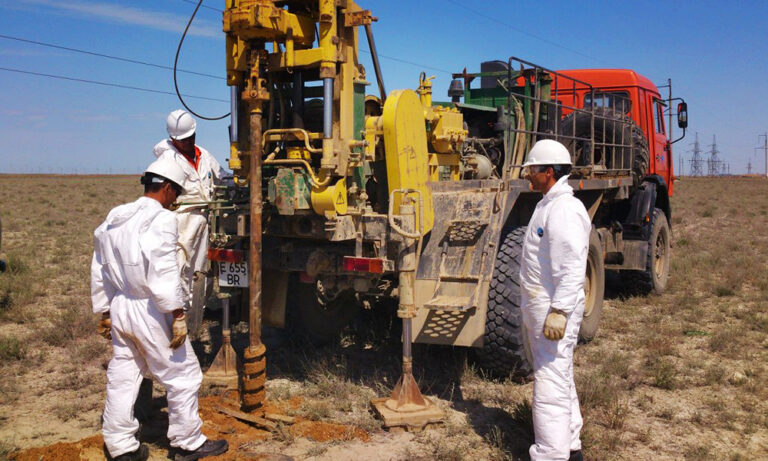
Topographic-geodetic and engineering-geological surveys, 500 MW WPP (Samarkand)
Engineering-geological survey of a power line (51 km), 500 MW solar plant (Sherabad)
Geotechnical studies, Nukus WPP (Karakalpakstan)
Cross-hole wave velocity measurements, 500 MW WPP (Bash, Zangeldy)
Engineering-geological surveys, 500 MW solar plant (Sherabad)
Engineering-geological surveys, combined power plant 1500–1700 MW (Uchkizil, Termez)
Geological exploration, «Dukhana» copper ore (Uzun district, Surkhandarya)
Engineering-geological surveys along a water-main route (65 km), Charvak — «New Tashkent»
Engineering-geological surveys (535 m drilling): Webster University and a school, «New Tashkent»
Engineering-geological surveys (635 m drilling): National Art Museum of Uzbekistan
Engineering-geological surveys (12 boreholes, 40 m each), «New Tashkent»
Thank you! Your request has been received
We will estimate the cost for your site and contact you shortly.