
Hydrogeological studies (groundwater investigation)
Engineering-geological surveys and laboratory soil testing.
Hydrogeological investigations are an indispensable component of comprehensive pre-design site surveys, focusing on the rigorous evaluation of aquifer horizons, groundwater dynamics, and the permeability parameters of water-bearing soil strata.
Study of the regime, level and chemical composition of groundwater to assess its impact on the foundations of structures.
In Tashkent and across all regions of Uzbekistan, the licensed engineering center GEO PRO delivers certified hydrogeological investigations Tashkent in strict compliance with national KMK and ShNK building codes. Comprehensive hydrogeological investigations eliminate the risk of water ingress into excavation pits, basements, and underground car parks.
Conducting an advanced groundwater survey for construction Uzbekistan provides structural designers with verifiable baseline parameters to calculate soil bearing capacity, select appropriate waterproofing systems, and design robust anti-seepage cutoff walls.
Timely identification of subsurface aquifers prevents catastrophic hydrodynamic soil liquefaction, internal suffosion erosion of fine particles, and uneven settlement of structures.
Hydrogeological Investigations: Key Objectives and Regulatory Compliance
Under the provisions of the Urban Planning Code of the Republic of Uzbekistan, performing specialized hydrogeological investigations is mandatory for:
- Multi-storey residential developments and commercial high-rises with deep multi-level basements;
- Industrial manufacturing plants, heavy machinery halls, and logistics hubs requiring deep foundations;
- Linear infrastructure projects: transportation tunnels, underground passages, road cuts, and bridge piers;
- Hydraulic structures, water intake facilities, irrigation channels, and wastewater treatment plants;
- Construction sites exposed to seasonal waterlogging, slope instability, and ground erosion hazards.
High-precision hydrogeological investigations ensure operational safety, structural integrity, and long-term durability for civil and industrial structures.
Field Measurements: Groundwater Table Level Determination Tashkent
During field exploration, hydrogeologists from GEO PRO establish routine monitoring networks in purpose-drilled observation boreholes.
Accurate groundwater table level determination Tashkent involves continuous depth logging of unconfined phreatic water tables, perched water lenses (verkhovodka), and deep confined artesian aquifers.
Our engineers determine seasonal and multi-year fluctuations of the groundwater surface, forecasting peak water levels during spring flood periods while accounting for urban anthropogenic factors.
The collected empirical data serves as the foundation for calculating hydrostatic uplift pressures on basement slabs, preventing the flotation of buried tanks, and designing dewatering schemes during deep excavation works.
In-Situ Field Testing: Hydrogeological Pumping and Permeability Testing
To determine the exact hydraulic conductivity of water-bearing strata, our field teams execute in-situ hydrodynamic aquifer tests.
We perform standardized hydrogeological pumping and permeability testing (single-well, cluster-well, and step-drawdown pumping tests) with automated logging of discharge rates and recovery curves:
- Determination of filtration coefficients for gravels, sands, silts, and loams;
- Calculation of the cone of depression radius and zone of influence for dewatering systems;
- Evaluation of transmissivity, storativity, and inter-aquifer leakage parameters;
- Execution of double-ring infiltration tests and water injection tests in the unsaturated vadose zone;
- Hydrodynamic mathematical modeling of water inflow into construction pits and utility trenches.
Detailed hydrogeological investigations enable our engineering team to design optimized construction dewatering systems and select suitable pumping units with correct operational capacity.
Laboratory Testing: Groundwater Chemical Analysis and Concrete Aggressiveness
The mineral composition and dissolved ions in groundwater dictate the long-term chemical durability of subsurface reinforced concrete and steel structures.
In our certified analytical laboratory, groundwater chemical analysis and concrete aggressiveness are evaluated in accordance with GOST and international testing standards:
- Measurement of pH value, total dissolved solids (TDS), and total water hardness;
- Quantitative determination of aggressive carbon dioxide, sulfate ions, chlorides, and nitrates;
- Assessment of leaching, general acid, magnesium, and carbonic acid aggressiveness against various concrete grades;
- Corrosion rate assessment for reinforcement steel bars and structural steel foundation piles.
Based on laboratory certificates, our engineers issue concrete durability recommendations, including sulfate-resistant Portland cements and specialized elastomeric waterproofing membranes.
Technical Reporting and State Expertise Approval
Following field testing and laboratory assays, GEO PRO compiles an official technical report complete with hydrogeological cross-sections, water table contour maps, and predictive flooding models.
All hydrogeological investigations conducted by our center comply with technical regulatory guidelines and guarantee seamless approval by the State Urban Planning Expertise.
Order Hydrogeological Surveys in Uzbekistan with GEO PRO
GEO PRO operates its own fleet of drilling rigs, heavy-duty submersible pumping equipment, and an engineering team with over 15 years of industry experience.
If you need to optimize project budgets, safeguard deep foundations, or order hydrogeological surveys in Uzbekistan, submit an online inquiry — our specialists will deliver a commercial proposal within 1 business day.
Need this service? Leave a request — we’ll estimate the cost for your site. Request an estimate or call: +998 97 744-55-11.
Why choose us
Licenses and permits
We work officially: a laboratory and permits for engineering surveys.
Modern equipment
Modern total stations, GNSS receivers and drilling rigs.
Experienced engineers
Surveyors, geologists and ecologists with specialized education and on-site experience.
Official report
A technical report accepted by expert review bodies and design organizations.
How we work
Request and brief
We clarify the task, site and objectives, and agree on the brief and cost.
Field work
We go on-site: measurements, survey, drilling and sampling to standards.
Processing
Office data processing, calculations and analysis in specialized software.
Report
We prepare and deliver an official technical report with results and recommendations.
Our work: geology
Projects completed by GEO PRO in this field — total 17.
Pile testing (Pile Drive & Pull-Out), Samarkand 2 Solar 500 MW
Drilling works (2000 m), Fergana region
Geotechnical surveys, LNG peak-shaving facility (Syrdarya, Tashkent, Turakurgan)
Steel pile test (DVT), photovoltaic plant (Kashkadarya)
Topographic-geodetic and engineering-geological surveys, Andijan PV plant 400 MW
Geotechnical and geophysical works, «Bash and Jankeldy» (Bukhara region)
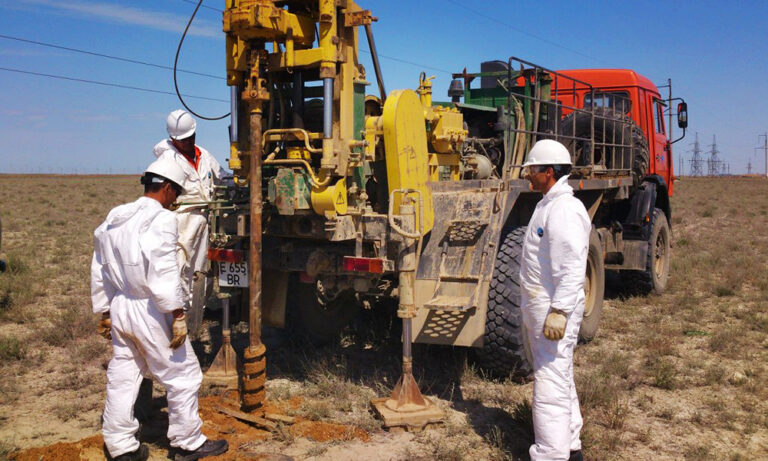
Topographic-geodetic and engineering-geological surveys, 500 MW WPP (Samarkand)
Engineering-geological survey of a power line (51 km), 500 MW solar plant (Sherabad)
Geotechnical studies, Nukus WPP (Karakalpakstan)
Cross-hole wave velocity measurements, 500 MW WPP (Bash, Zangeldy)
Engineering-geological surveys, 500 MW solar plant (Sherabad)
Engineering-geological surveys, combined power plant 1500–1700 MW (Uchkizil, Termez)
Geological exploration, «Dukhana» copper ore (Uzun district, Surkhandarya)
Engineering-geological surveys along a water-main route (65 km), Charvak — «New Tashkent»
Engineering-geological surveys (535 m drilling): Webster University and a school, «New Tashkent»
Engineering-geological surveys (635 m drilling): National Art Museum of Uzbekistan
Engineering-geological surveys (12 boreholes, 40 m each), «New Tashkent»
Thank you! Your request has been received
We will estimate the cost for your site and contact you shortly.